Self-Employment Tax Solution
Why Traditional Tax Systems Struggle with Self-Employment Income

Today’s labor market has undergone a fundamental paradigm shift. We have moved away from the traditional economic model characterized by clear employers, fixed workplaces, predictable 8-hour workdays, and straightforward pay-as-you-earn tax withholding. In today’s dynamic economy, millions of people earn income every single day while remaining completely invisible to the tax system. Their transactions remain unregistered, leaving no record, no invoice, no tax contribution, and no formal economic history.
In this article, we explore the challenges of taxing self-employment income in the modern digital economy and discuss a practical approach to voluntary formalization that benefits governments, businesses, and workers.
The Growing Shadow: Risks and Realities of Informal Self-Employment
This widespread informality carries profound risks for every segment of society. For workers, it means a severe lack of social protection, including no access to formal healthcare, sick leave, or old-age pensions. For businesses, relying on informal employment translates to lower productivity and limited access to formal finance and credit. For governments, the informal sector represents a massive, ongoing loss of tax revenue and a distorted view of the true economic activity within the country, making effective budget planning nearly impossible.
The scale of this challenge is staggering. According to the International Labour Organization (ILO), over 60% of the world’s labor force works in the informal sector, representing around 2 billion people. The OECD reports that a striking 87% of self-employed workers operate in informal economic units. The situation is particularly acute in emerging and developing regions: the ILO estimates that 83% of economic units in these countries are informal. In Africa, this figure reaches an astonishing 93%.
But why is informal self-employment growing so rapidly right now, and why is it becoming increasingly difficult to control? The answer lies in the explosive growth of the digital and gig economy. Millions of workers are now operating as independent contractors on freelance platforms, delivery apps, and digital marketplaces. While these platforms create jobs, they often classify workers as self-employed, completely bypassing traditional employer tax withholding systems. Furthermore, the rapid proliferation of mobile money, digital wallets, and fast payment systems — especially vital in African markets — means millions of micro-transactions occur daily outside the traditional banking sector. Traditional audit methods are simply too resource-intensive and inefficient for revenue authorities to track these highly fragmented, low-value digital transactions. The economy has changed faster than the mechanisms of tax administration, leaving governments blind to a vast portion of their own GDP.

Why Pressure Alone Fails: The Case for Voluntary Formalization
When faced with insufficient tax revenue and growing budget deficits, the instinctive reaction of some governments is to raise tax rates or tighten punitive enforcement. However, this approach often backfires, creating a dangerous vicious circle. Higher tax rates place a heavier burden on the few compliant taxpayers, discouraging them and pushing even more people into the shadow economy. As the shadow economy grows, the tax base shrinks further, tempting the government to raise rates again.
Simple pressure and punitive measures do not work for the self-employed. If the risk of being audited is low (due to a lack of administrative resources) and the process of registration is notoriously complex, individuals will choose to remain informal.
To break this cycle, tax authorities must shift their strategy. Instead of relying solely on "deterring by detection", the focus must move toward "assisting to comply" and, ultimately, "making it easy" for those willing to do the right thing. The goal should be to encourage voluntary compliance by actively removing the barriers to formalization. This requires a two-step approach: first, introduce a preferential tax rate and a special, simplified tax regime for self-employed workers to reduce the barriers to entry. Second, for those who still choose not to comply, tighten digital audit measures and impose control over bank and mobile transactions. The foundation of this strategy, however, must be making formalization genuinely attractive.

The Power of Simplified Tax Regimes: Global Success Stories
The most effective way to bring self-employed workers into the formal economy is through a dedicated, simplified tax regime.
The core concept is straightforward and highly successful globally: offer a low, predictable tax rate (typically recommended between 4% and 6% of income), eliminate the need for complex tax declarations, and allow for remote, digital registration.
Global experience proves that this model works.

Uruguay: Monotax
Uruguay's Monotax (Monotributo) is a simplified, unified tax and social security contribution system introduced in 2001 and reformed in 2007 to bring micro-enterprises and independent workers out of the informal economy. It combines income tax and social security contributions into a single, affordable monthly payment based on income brackets. Monotax is collected via the Social Security Institute (Banco de Previsión Social), which then allocates portions to general fiscal authorities.
The system extends health, pension, and other social protection benefits to self-employed workers and has proven to be an effective instrument for formalization. The International Labour Organization notes that the system successfully tripled the number of covered firms and workers within three years of its 2007 reform.

Rwanda: the "Flat Amount" Model
In Rwanda, the "Flat Amount" tax regime replaces complex accounting rules with predictable, fixed costs. The regime strictly categorizes businesses based on their annual turnover brackets or asset types, ensuring that the smallest operators face zero administrative friction.
For standard micro-enterprises (general retail and services) earning under 12 million Rwandan Francs per year, taxes are broken down into four fixed tiers based on estimated annual revenue. Tracking the actual cash revenue of thousands of individual transport operators — such as moto-taxis, minibus taxis, trucks, and buses — is logistically impossible for a tax authority. To bypass this, Rwanda uses a flat tax system structured by vehicle type, seating capacity, or engine size.
By aligning the tax obligation with real financial capabilities of small businesses and allowing for simplified payment channels, Rwanda has successfully broadened its tax base.

Kenya: eTIMS Lite
Another example comes from Kenya, where the Kenya Revenue Authority (KRA) recognized that the informal sector was a massive source of lost revenue. To close this gap, KRA introduced the Electronic Tax Invoice Management System (eTIMS), specifically tailoring eTIMS Lite for informal sector workers and gig workers. This digital tool allows self-employed individuals to issue electronic tax invoices and register transactions using basic mobile phones, without needing expensive hardware or complex software.
By integrating tax compliance directly into the digital and mobile tools that Kenyans already use daily, KRA has made it significantly easier to track informal income and bring millions of micro-transactions into the formal tax net.
These examples show that when governments provide a financially attractive and administratively simple pathway, self-employed workers are eager to step into the light, gain legal status, and contribute to the national economy.

Legislation Is Only Half the Battle: The Need for Digital Tools
However, passing a law to create a simplified tax regime is only the first step. If a self-employed worker still has to travel to a tax office, fill out paper forms, manually calculate their own taxes, and stand in line at a bank to pay, the new law will fail. Legislation must be paired with robust, user-friendly digital infrastructure.
To truly enable voluntary compliance, governments need effective digital tools that automate the entire tax lifecycle.

Remote Identification and Registration
Allowing workers to register and obtain a Taxpayer Identification Number (TIN) in under five minutes via a mobile app or web portal, using basic ID and selfie verification, with no need to visit a tax office.

Automatic Tax Calculation
Eliminating the need for workers to file declarations or do math. The system should automatically calculate the tax owed based on registered income at the end of a short, manageable tax period (e.g., one month).

Electronic Fiscal Receipts
Enabling workers to issue digital receipts directly from their smartphones without the need to purchase, maintain, or install expensive physical cash registers.

Multichannel Payment Options
Integrating seamlessly with mobile money, USSD codes, and bank cards, recognizing that in many African countries, mobile money is the primary and most trusted financial tool.
Furthermore, the ecosystem should leverage strategic partnerships. Banks can integrate tax registration into their client onboarding flows. Telecom operators can facilitate seamless, low-cost tax payments. Job platforms and service aggregators (like ride-hailing or freelance marketplaces) can act as withholding agents, automatically registering the self-employed and remitting taxes on their behalf.
A Win-Win Solution: The traceCORE Self-Employment Tax Solution
Designing and implementing this digital ecosystem from scratch is a complex challenge, but it is one that can be solved with the right technology partner. The traceCORE Self-Employment Tax Solution is specifically designed to help governments diminish the prevalence of informal employment and establish a regulated, formalized labor market that benefits everyone.
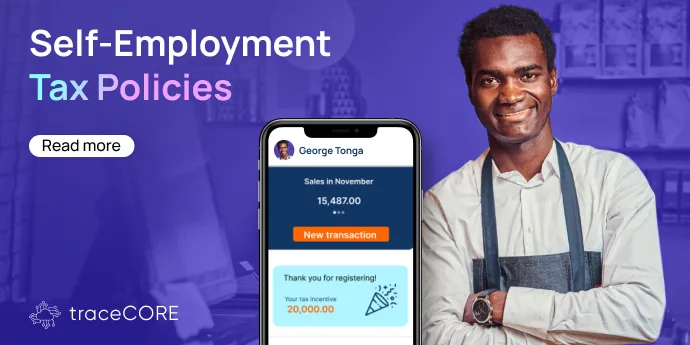
traceCORE provides a comprehensive, high-quality mobile app and web portal that feels as intuitive as the best consumer fintech applications. No advanced ICT skills are required; anyone familiar with a smartphone can learn to use it.
The solution automates monthly tax calculations, generates electronic fiscal receipts, and supports seamless integration with the central tax authority’s core system for real-time digital audits and business intelligence.
Additionally, traceCORE includes innovative consumer engagement tools to improve compliance organically. For example, customers who purchase services from a self-employed worker can scan a QR code on the electronic receipt to receive a tax cashback or a lottery entry, turning everyday citizens into active, motivated participants in promoting tax compliance.
Conclusion
The transition from a traditional employment model to a modern, gig-driven digital economy has outpaced legacy tax administration systems, leading to a booming informal sector that deprives governments of vital revenue and workers of essential social protections.
As demonstrated by global success stories from Uruguay, Rwanda, and Kenya, punitive measures alone cannot solve this issue. The key to success lies in voluntary formalization driven by simplified tax regimes (typically 4-6%), frictionless digital registration, and automated compliance tools. By leveraging modern technology solutions like the traceCORE Self-Employment Tax Solution, governments can transform tax compliance from a burdensome chore into an accessible, rewarding process.
Ultimately, bringing self-employed workers out of the shadow economy is not just about increasing tax collection; it is about fostering inclusive economic growth, expanding the tax base, and ensuring a secure financial future for millions of citizens.