Self-Employment Tax Solution
How Mobile-First Platforms Can Democratize Tax Participation

In an era where digital access defines participation in economic systems, tax administrations around the world are harnessing mobile-first platforms to transform how taxpayers interact with the fiscal state.
While it still might sound impossible to some people, paying taxes nowadays can be just as easy as sending a text message, and registering as a taxpayer takes minutes instead of hours. Mobile-first platforms are turning it all into reality — and transforming the way government agencies interact with citizens.
In this post, we explore how such solutions are rewriting the rules of tax participation, while expanding inclusion, simplifying compliance, and boosting government revenue.
Why Democratizing Tax Participation Matters
Many people around the world view taxation as an extremely complex and even intimidating process. It’s especially true for the self-employed — gig workers, artisans, freelancers, street vendors, and countless others.

But the reality is that a large share of workers worldwide operates in the informal economy — many of them by choice, many by necessity. Traditional systems often require a lot of extra time to visit government offices and a level of financial literacy that isn’t realistic for everyone.
As a result, billions of people aren’t fully integrated into the tax base, even though they may significantly contribute to government revenue collection. For example, in Ghana, the informal sector contributes over 27% to GDP, according to The Business and Financial Times. Despite that, the informal sector’s contribution to total tax revenue remains tiny — often less than 5%.
That’s where mobile-first platforms come in.
How Mobile-First Platforms Change the Game
Mobile phones are now everywhere. When tax services move to the device people already use every day, they stop being administrative hurdles and become practical tools citizens start using regularly.
This shift isn’t just theoretical — according to the OECD and IMF, it shows real improvements:
-
Governments see faster onboarding and registrations when they offer apps or mobile access to tax services.
-
Self-employed taxpayers are more willing to participate when they can track their receipts, calculate what they owe, and pay directly from their phone.
-
Compliance improves organically because the friction that once repelled people — like paperwork and office visits — disappears.
traceCORE Self-Employment Tax Solution: Practical Tax Inclusion
Take a look at platforms like traceCORE Self-Employment Tax Solution — a mobility-powered system that helps self-employed workers navigate tax obligations with confidence.
traceCORE’s solution lets users:
-
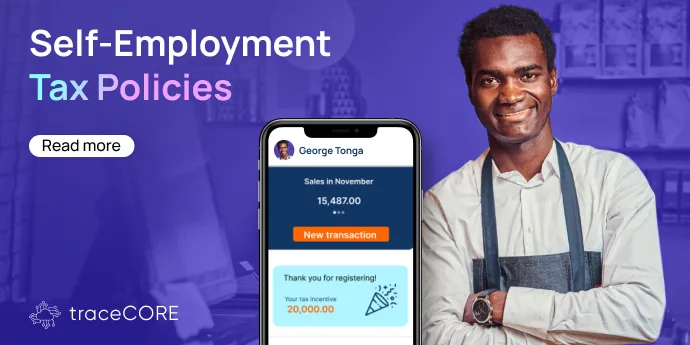
Register as taxpayers in minutes via the app or website
-
Record and issue receipts from their phone
-
Automatically calculate taxes and file returns
-
Pay securely without visiting the tax office in person
To learn more about traceCORE Self-Employment Tax Solution, visit this page.
The OECD notes that countries that adopt mobile solutions as part of a broader digital strategy, this translates into more people entering the formal economy, better data for government planning, and a bigger tax base without heavy enforcement.
It’s not magic — just meeting people where they already are: on their mobile devices.
Mobile Tax Innovations In Developing Countries
Here are some mobile tax innovation examples from African countries and other developing regions — showing how mobile-first tools are being used to make tax systems more accessible, efficient, and inclusive.

South Africa — SARS Mobile Tax Services
The South African Revenue Service (SARS) has developed mobile tax access channels that work on both smartphones and basic mobile phones:
-
SARS MobiApp lets users register, submit income tax returns, and make payments directly from a smartphone app.
-
USSD and SMS services allow taxpayers without internet access or smartphones to request key tax information and interact with the system via simple codes and text messages.
-
SARS even supports WhatsApp messaging for general tax queries. This mix of mobile channels expands access beyond traditional portals.

Uganda — Mobile Money Integration for Taxes
Uganda has been a pioneer in mobile money-enabled tax payments:
-
The tax authority has connected mobile money platforms (like MTN Mobile Money and Airtel Money) to its registration and payment systems, making it easy for small traders to pay turnover taxes and filing fees.
-
Integrating mobile money has helped register over 350,000 informal taxpayers and enabled a significant share of tax payments digitally — with reports indicating about 25% of tax payments now occurring through digital and mobile channels.

Kenya — Mobile Tax Payments & Digital Levies
In Kenya, while taxation innovations have included digital service taxes on mobile financial transactions, the widespread use of M-Pesa (Safaricom’s mobile money) has made it simpler for many small businesses and informal workers to pay taxes and levies without needing bank accounts.
This illustrates how financial infrastructure built for everyday use becomes a tax compliance channel.

Burundi — Online Tax Filing and Payments
Burundi’s Revenue Authority launched an online filing and payment platform in 2023 that’s mobile-accessible, enabling taxpayers to file returns and pay taxes across devices.
Digital tools have been coupled with awareness efforts to bring more small businesses into formal tax participation.

Digital Invoice & Receipt Platforms — Ghana and Across Africa
Commercial solutions like Tax QR and digital invoice apps developed with local revenue authorities allow small traders to generate tax-compliant digital invoices via mobile apps or even USSD, reporting transactions in real time and making VAT and turnover tax compliance easier.
This reduces paperwork and gives tax authorities instant access to transaction data.

Morocco — Daribati Mobile App
Morocco’s tax authority operates the Daribati mobile application, which taxpayers use to make digital tax payments.
This helps busy small business owners and individuals settle their obligations without queues or desktop portals.
Why These Mobile Innovations Matter in Developing Contexts
Across Africa and similar developing regions, mobile money penetration often outpaces bank account ownership, making mobile platforms a natural channel for tax interactions.
Governments are explicitly linking tax systems with digital public infrastructure (like national IDs and mobile money) to broaden the tax base, especially among informal and micro-enterprises.
In addition, simple mobile channels like USSD and SMS help bridge internet access gaps, enabling compliance without data-intensive apps.
These innovations show that mobile-first tax systems are not abstract goals — they’re concrete tools helping governments make tax participation easier, faster, and fairer for millions of people who might otherwise remain outside the formal economy.
How Mobile-First Solutions Improve Tax Compliance
Governments and international bodies report clear trends showing that digital tools support compliance:
.webp)
Higher Self-Service Use Leads to Better Compliance
The OECD Tax Administration 2025 report shows that offering self-service channels — including mobile — increases voluntary compliance by making tax obligations easier to understand and fulfill.
Simplified digital interactions support taxpayer trust and participation.

Digital Mobile Payments and Reporting Improve Transparency
Studies — like this 2022 UNU-WIDER working paper, for example — find that mobile money and mobile tax payment tools facilitate transparency and increase voluntary tax compliance in developing countries, where feature phone and smartphone penetration is high.
Embedding Services in Everyday Platforms Reduces Burden
In their Tax Administration 2023 report, the OECD also stated that shifting tax services into “natural systems” used by taxpayers — such as mobile and banking apps — reduces administrative costs and encourages compliance by removing friction from the process.
Mobile Transaction Reporting Enhances Data Quality
Mobile invoicing, QR codes, and real-time tax reporting tools (seen in apps like mPorezna) improve data quality for tax authorities — enabling smarter risk profiling and fewer audits.
Social and Economic Impact of Mobile-First Platforms
When tax participation becomes easier through mobile:
People feel acknowledged and included.
They see taxes not as a burden but as part of their economic identity and access to benefits like credit or public services.
Governments gain better data.
With digital receipts and electronic trails, authorities can analyze trends, tailor services, and even design policies that serve citizens better.
Small businesses become more confident.
When they can track revenue on an app and pay taxes with a tap, they start planning for long-term growth.
This is what we mean by democratizing tax participation — shifting from a top-down, intimidating process to an accessible, everyday civic experience.
Takeaways for Governments Ready to Innovate
To harness the full power of mobile-first tax platforms, governments should:
-
Design mobile services with citizens in mind, not just tax rules. Simplicity and clarity matter.
-
Integrate with digital identity systems, so registration and authentication are seamless.
-
Partner with telecoms and mobile money providers, extending reach to people who may not have traditional bank accounts.
-
Support digital literacy, especially where feature phones are still common.
-
Measure and iterate — track who’s using the app and continuously improve the experience.
Conclusion
Mobile-first tax platforms are transforming the tax experience from a barrier into a bridge — one that connects citizens, jobs, growth, and public services.
When tax participation is simple, transparent, and mobile-friendly, more people will not only comply — they will engage, trust, and contribute to their societies in ways that go well beyond revenue figures.