
Anti-Money Laundering Platform
Identify, analyze, and prevent suspicious financial activity across the national economy.
Book a demo
Government Impact of Money Laundering
Money laundering causes major financial losses for governments by enabling corruption, tax evasion, and illicit financial flows. These losses reduce public funding for essential services and national development.
It also weakens financial systems, increases compliance risks, and undermines economic stability. Strong AML regulations help governments improve transparency, protect public revenue, and strengthen trust in institutions.
.webp)
Financial flows lack transparency
According to FATF, large volumes of cross-border and domestic transactions move through fragmented systems with limited visibility.
This makes it difficult for authorities to identify the true origin, destination, and purpose of funds.

Complex layering of illicit funds
As reported by FATF, criminal proceeds are often split, transferred, and re-routed through multiple accounts and intermediaries.
This layering makes it difficult for regulators to trace funds back to their original source.

Informal and unregistered economic activity
A significant share of financial activity occurs outside formal registration and reporting frameworks, FATF reports.
Individuals and businesses can generate and move income without proper oversight or tax declaration.
What is money laundering?
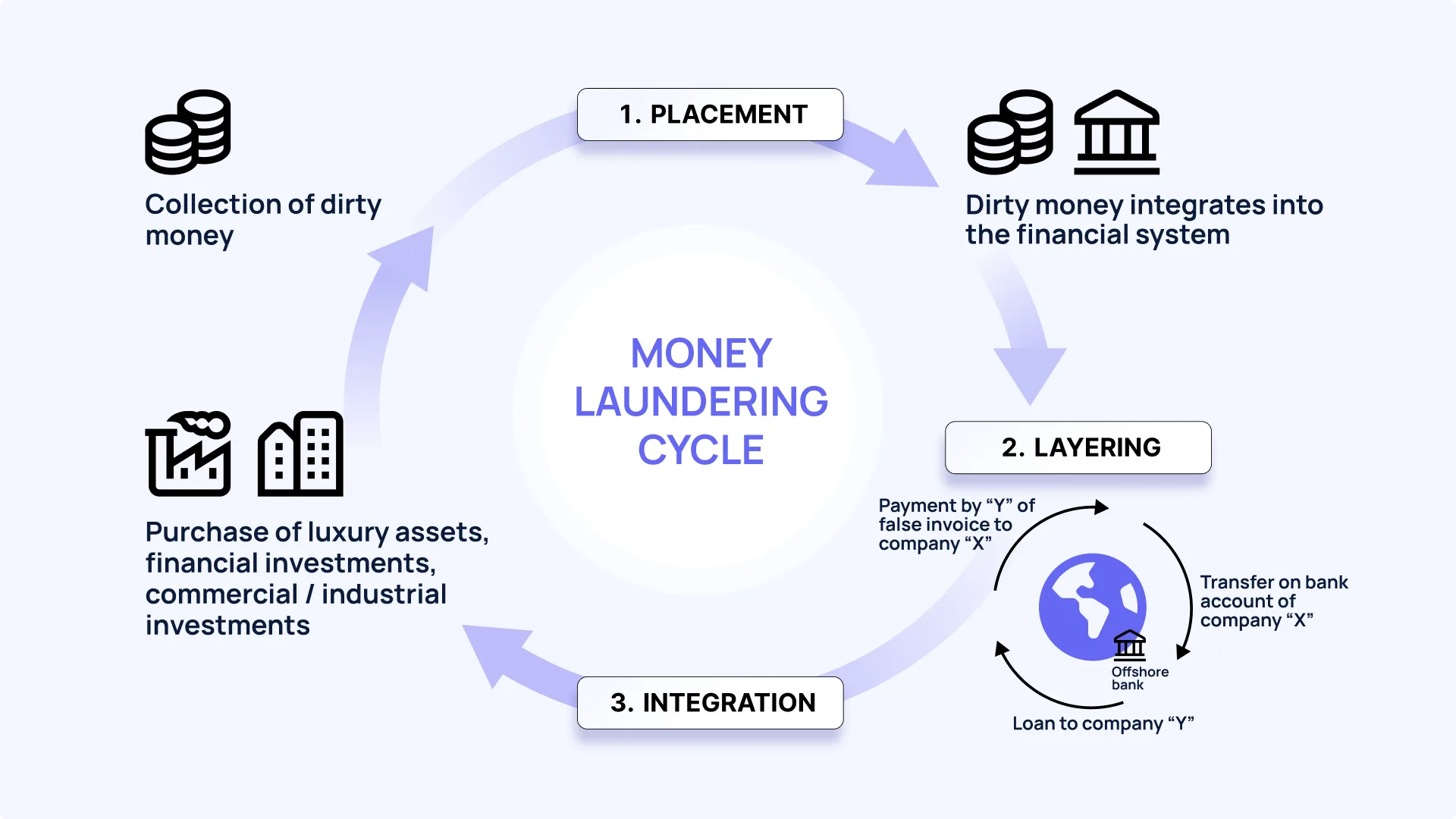
Money laundering is the process of disguising the origin of illegally obtained funds by moving them through financial transactions and systems to make them appear legitimate, often by using complex transfers, layering, and integration into the formal economy.
What is traceCORE Anti-Money Laundering Platform?
traceCORE Anti-Money Laundering Platform is a centralized national platform to detect, analyze, and prevent suspicious financial activity across the economy.
It connects banks, regulators, tax authorities, and government institutions into a single financial intelligence system for continuous monitoring of transactions and behavior across individuals and businesses.
The platform replaces fragmented compliance with a unified, real-time, data-driven control environment.

Identify hidden transaction chains and fund flows

Improve consistency of enforcement decisions

Automate compliance and regulatory reporting

Detect suspicious financial behavior in real time

Monitor cross-border capital movements

Reduce reliance on long manual investigations
How does traceCORE Anti-Money Laundering Platform work?

traceCORE Anti-Money Laundering Platform delivers measurable improvements across the financial ecosystem:
- Increased financial transparency across the economy.
- Reduced shadow economy activity.
- Higher tax compliance and reporting accuracy.
- Stronger control of cross-border transactions.
- Improved efficiency of regulatory operations.
- Better detection of complex fraud schemes.
- Unified financial governance across institutions.
traceCORE Anti-Money Laundering Platform automatically generates analytical reports and visualizes transaction flows in real time.
The system automatically detects suspicious activities and classifies them according to risk categories.
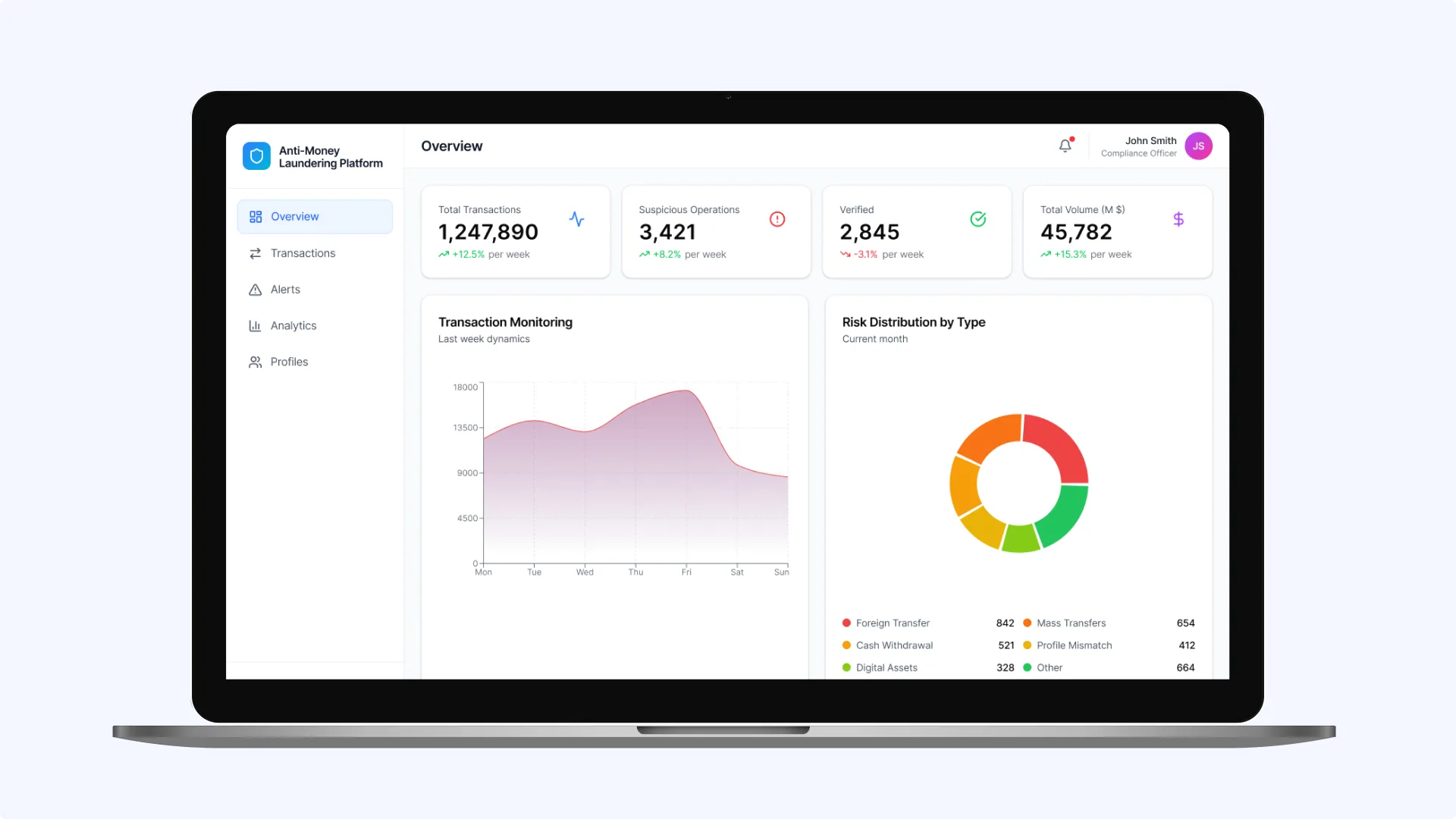
The platform automatically generates structured case files and reports on suspicious activities, reducing manual workload and accelerating compliance and regulatory review.
AI-powered rule optimization and behavioral analytics

Modern compliance architecture should include an AI-enhanced analytical layer designed to improve existing regulatory rules.
The module continuously analyzes the effectiveness of detection scenarios, identifies inefficient or “noisy” rules, dynamically adjusts thresholds, and segments customers based on behavioral patterns.
This approach helps reduce false positives, improve operational efficiency, and enable more accurate detection of suspicious activities and anomalies.
Anomaly detection engine & Analytical layer

The anomaly detection engine, unlike traditional rule-based monitoring, identifies unknown patterns and unusual combinations of indicators, enabling adaptive detection of emerging risks and schemes.
The analytical layer builds transaction and entity profiles based on behavioral patterns, counterparty relationships, risk factors, and financial activity context, helping organizations assess both the alert and its significance.

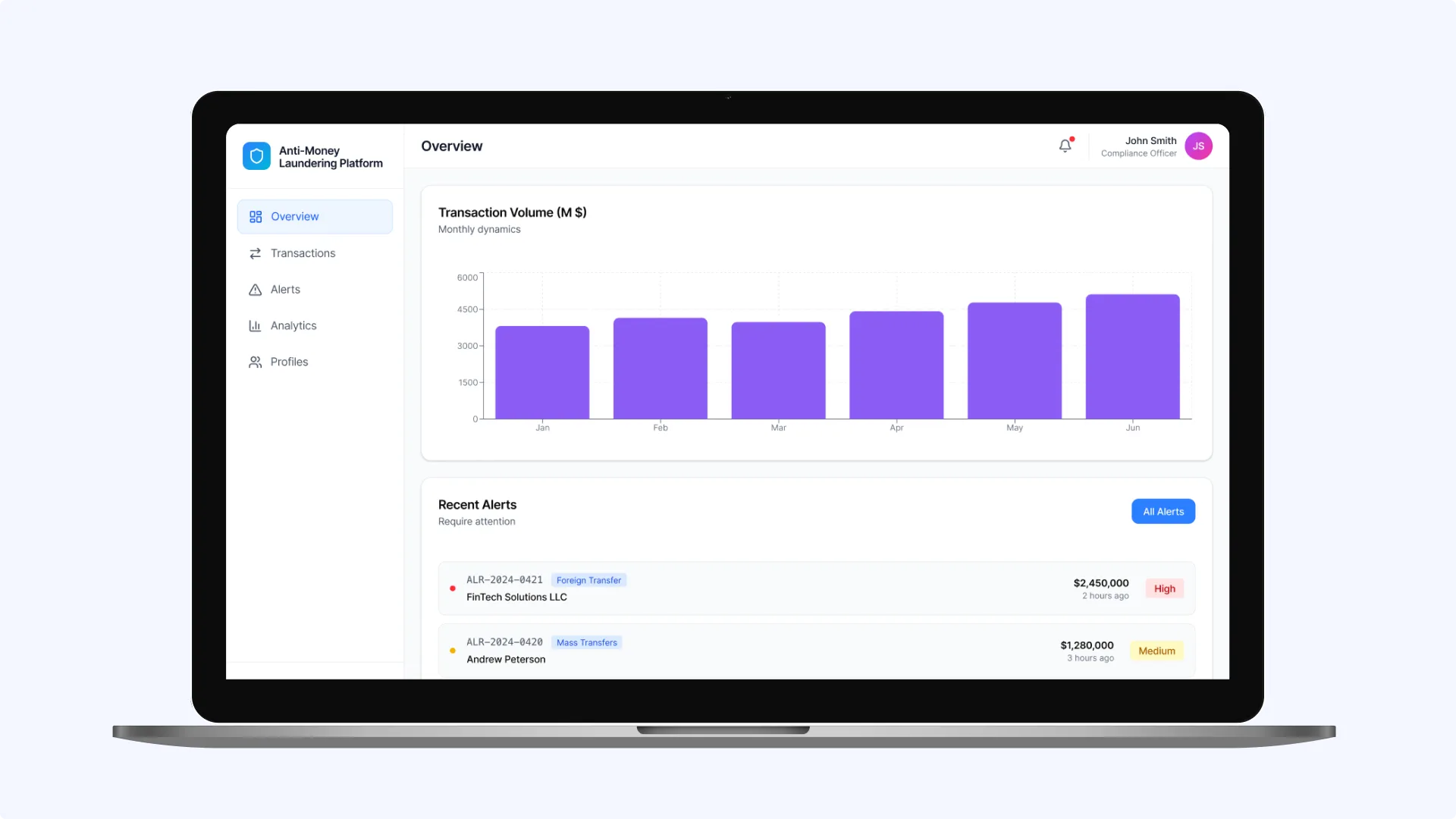
The analytical layer evaluates transactions against predefined scenarios, including cross-border transfers, mass card transfers, profile inconsistencies, suspicious counterparties, cash activity, digital assets, and other risk indicators.
If a transaction matches one or more scenarios, an alert is generated. The analytical module and LLM agent then build transaction and entity profiles, assess the overall risk level, and provide an interpretable analysis of the result.
Key features

Behavioral risk analytics
Analyzes customer behavior patterns to identify anomalies and hidden risks.

AI-powered detection engine
Combines regulatory rules and AI models to detect known and emerging financial crime schemes.

Real-time transaction monitoring
Continuously monitors financial transactions to detect suspicious activity as it happens.

Automated compliance workflows
Automates alert generation, case management, and regulatory reporting processes.

Cross-entity relationship mapping
Reveals hidden connections between individuals, businesses, accounts, and transactions.

Explainable risk scoring
Provides transparent risk assessments with clear reasoning behind every alert and decision.
A win-win solution for all stakeholders
Delivering measurable value through unified financial oversight, automated compliance, and intelligent risk detection.

- Full visibility over financial flows.
- Stronger enforcement capabilities.
- Reduced shadow economy.
- Improved fiscal efficiency.

- Improved income–expense matching.
- Detection of undeclared business activity.
- Increased tax base and revenue collection.

- Reduced compliance workload.
- Automated alert handling.
- Structured regulatory communication.
- Lower operational risk.

- Higher trust in financial systems.
- Reduced illicit financial activity.
- Improved transparency of cross-border flows.
Why choose traceCORE?

BigData analytics for informed decisions
Designed with simplicity and efficiency in mind, the platform provides intuitive dashboards, streamlined workflows, and easy navigation for regulators and compliance teams.

Exceptional user experience
The system delivers fast access to insights, clear alert interpretation, and seamless interaction across all monitoring and investigation processes.

Unified financial intelligence layer
Connects banks, regulators, and government systems into a unified ecosystem for centralized financial oversight.

Continuous learning system
The platform continuously improves detection accuracy by learning from historical cases, behavioral patterns, and emerging financial crime schemes.