Digital Platform Tax Solution

The Impact of Gig Work on Governments: How Can It Be Regulated?

Reading Time: 7 min.
Elena Ruseykina
Image

The gig economy has transformed the global labor market, bringing unprecedented flexibility and digital-first work models. From app-based delivery drivers to freelance developers, millions now earn income through platforms rather than traditional employment.  

While this shift fosters innovation and economic participation, it also presents serious regulatory and fiscal challenges for governments. The rise of gig work tests tax systems, social safety nets, and regulatory frameworks that were originally designed for conventional employment models — and many governments are scrambling to adapt. 

In this article, we unpack the core issues governments face with gig work and explore how traceCORE Digital Platform Tax Solution can help governments and platforms manage tax compliance effectively. 

Why the Gig Economy Is a Strategic Issue for Governments

Icon

Revenue Collection in a Fragmented Labor Market

Tax leakage is one of the most immediate concerns for governments. Gig workers often earn income from multiple platforms, sometimes across jurisdictions, and frequently without automatic withholding. This creates significant gaps in income tax and social contribution collection. 

Unlike traditional employment, where taxes are deducted at source, gig income typically relies on self-reporting — a model that becomes increasingly unreliable at scale. According to the OECD, a substantial share of platform-based income goes unreported, directly affecting public budgets and long-term fiscal sustainability. 

Icon

Pressure on Social Security and Welfare Systems

When gig workers fall outside formal employment structures, they often do not contribute consistently to pension schemes, health insurance, or unemployment funds, as stated in a 2022 report by the Geneva Association. Over time, this weakens social protection systems and shifts the burden to governments — especially during economic downturns or public crises. 

This raises a key policy dilemma: how to preserve labor flexibility while ensuring that social security systems remain adequately funded and inclusive

Icon

Regulatory Visibility and Market Oversight

The OECD found that digital labor platforms generate vast amounts of real-time data — yet governments often lack structured access to it. Without reliable income and activity data, regulators struggle to: 

  • Assess the true size of the gig economy 

  • Detect tax evasion or non-compliance 

  • Design evidence-based labor and fiscal policies 

This lack of visibility creates an uneven playing field and undermines trust in digital markets. 

Icon

Data Governance, Digital Sovereignty, and National Control

2024 research by Springer reveals that beyond taxation and labor policy, the gig economy raises critical questions about data ownership, control, and digital sovereignty.  

Gig platforms generate vast volumes of economically sensitive data — including income flows, workforce participation, geographic demand patterns, and consumer behavior. In many cases, this data is held by private or foreign-owned platforms, limiting governments’ visibility into strategically important segments of their own economies. 

Gig Work Regulations Implemented by Governments Today 

Governments across regions are experimenting with different regulatory strategies: 

  • Employment status clarification, particularly in the EU, where policymakers aim to distinguish genuine self-employment from disguised employment relationships. 

  • Mandatory platform reporting requirements, obliging digital marketplaces to share worker income data with tax authorities. 

While these measures represent progress, they often rely on manual reporting, fragmented systems, and reactive enforcement. As platform economies continue to grow, these approaches risk becoming costly, slow, and difficult to scale. 


The Need for Digital-First Regulation of Gig Platforms 

From a government perspective, the regulation of gig work is not only a legal issue — it is a technology and infrastructure challenge

Effective regulation today requires: 

  • Automated data exchange between platforms and authorities 

  • Real-time or near-real-time tax reporting 

  • Scalable systems that can handle millions of micro-transactions 

  • Flexibility to adapt quickly to legislative changes 

This is where digital transformation solutions can play a decisive role. 


traceCORE Digital Platform Tax Solution: Enabling Smart Gig Economy Regulation 

traceCORE Digital Platform Tax Solution is designed specifically to address the tax compliance challenges of digital labor markets. Rather than forcing governments to pursue individual gig workers, the solution enables platform-level compliance, aligning regulatory oversight with how the gig economy actually operates.  


What Makes traceCORE Digital Platform Tax Solution Relevant for Governments 

traceCORE Digital Platform Tax Solution acts as a tax compliance layer between digital platforms and public authorities, functioning as both a tax agent and personal data operator. Its core purpose is to formalize gig-economy income streams without undermining platform flexibility

Key capabilities include: 

  • Automated registration of gig workers as self-employed or individual entrepreneurs 

  • Secure, standardized income data exchange with tax authorities 

  • Automated calculation and reporting of taxes and social contributions 

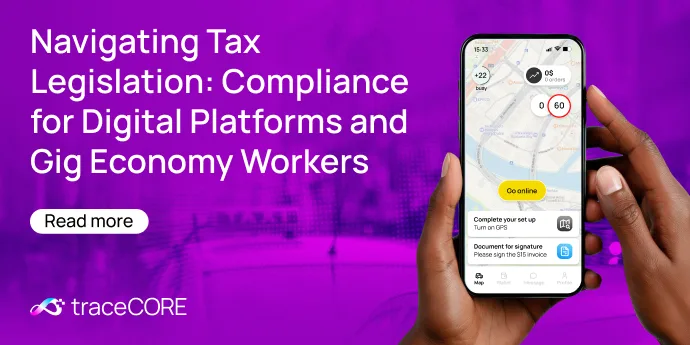
  • Digital document signing and worker confirmation via mobile applications 

  • Continuous monitoring of legislative changes to ensure compliance 

Visit this page to learn more about traceCORE Digital Platform Tax Solution. 

Benefits of traceCORE Digital Platform Tax Solution

For Governments and Tax Authorities
  • Improved revenue collection through systematic, automated reporting 

  • Greater transparency into platform-based economic activity 

  • Reduced administrative burden and lower enforcement costs 

  • Better policy design, supported by reliable data 

For Digital Platforms
  • A unified compliance solution that reduces regulatory risk 

  • Lower internal development and maintenance costs 

  • Clear alignment with government requirements 

For Gig Workers
  • Simplified tax compliance 

  • Formal income documentation 

  • Improved access to financial services, credit, and social benefits 

traceCORE supports collaborative governance, where governments set the rules and digital solutions enable efficient implementation. 

 
Conclusion 

The gig economy is reshaping labor markets faster than traditional regulatory systems can respond. Governments face the dual responsibility of supporting innovation while protecting public interests — from tax revenue to social security sustainability. 

The path forward lies in digital-first regulation, where technology enables smarter oversight rather than heavier bureaucracy. Solutions like traceCORE Digital Platform Tax Solution demonstrate how governments can partner with technology providers and digital platforms to bring gig work into the formal economy — transparently, efficiently, and at scale. 

For public-sector leaders, this is not simply a compliance upgrade; it is a strategic investment in the future of work and public finance.  

#digital labour platforms #gig economy #gig work #own-account workers #informal self-employment #digital transformation

Related Posts

All posts
Top