
Nonresident Taxation Platform
The Hidden Revenue Leak: Why Nonresident Tax Compliance Needs Digital Enforcement

When governments think about revenue leakage, the usual suspects come to mind: tax evasion, underground economies, or domestic fraud. Yet one of the fastest-growing challenges often flies under the radar are tax obligations of nonresident businesses.
As cross-border commerce becomes increasingly digital, businesses can generate substantial revenue in jurisdictions where they have little or no physical presence. While international tax rules continue to evolve, one challenge remains remarkably consistent: identifying taxable activities, ensuring accurate reporting, and collecting the taxes that are legally due.
The result is a significant loss of public revenue that can often be prevented.
For tax authorities, this isn't simply an administrative inconvenience. It directly impacts funding for infrastructure, healthcare, education, and public services. The good news? Modern digital enforcement technologies are making it possible to close these compliance gaps without placing unnecessary burdens on compliant businesses.
In this post, we'll examine why nonresident tax compliance has become a growing challenge for governments, the revenue risks it creates, and how digital transformation tools can help tax authorities close compliance gaps and strengthen revenue collection.
The scale of the problem
The financial impact of cross-border tax compliance gaps is staggering, and it's only becoming more difficult for governments to keep pace.
According to the Tax Justice Network's 2024 State of Tax Justice report, governments around the world lose an estimated US$492 billion every year to international tax abuse, including profit shifting by multinational corporations and offshore tax evasion. While this figure extends beyond nonresident taxation alone, it underscores the enormous amount of revenue that can slip through the cracks when cross-border economic activity isn't effectively monitored.
At the same time, the volume of cross-border trade continues to grow. As reported by Statista, global retail e-commerce sales now exceed US$6 trillion annually, enabling businesses to reach customers in virtually any market without establishing a physical presence. For tax authorities, this creates a fundamental enforcement challenge: identifying when nonresident businesses have tax obligations and ensuring those obligations are met.

Recognizing this shift, the OECD reports that more than 100 jurisdictions have introduced dedicated VAT/GST rules for nonresident suppliers of digital services and e-commerce. This widespread adoption reflects a clear reality: traditional tax administration systems were not designed for today's digital economy, where taxable activity increasingly crosses borders at the click of a button.
The message is clear. As international commerce becomes more digital and borderless, governments need modern tools that can identify, monitor, and enforce tax compliance in real time. Without digital enforcement, a growing share of taxable activity risks remaining invisible, along with the public revenue it should generate.

Why traditional enforcement falls short
Most tax administrations still rely heavily on manual processes, fragmented databases, and post-filing audits, according to the OECD.
Unfortunately, nonresident taxation presents a very different challenge from domestic compliance.
Foreign businesses may:
-
operate without a local establishment;
-
sell through digital platforms or intermediaries;
-
have inconsistent registration information across jurisdictions;
-
remain completely outside traditional taxpayer databases.
By the time discrepancies are identified, the business may have ceased trading, changed corporate structures, or shifted operations elsewhere.
This reactive model makes enforcement expensive, slow, and increasingly ineffective.

Digital transformation changes the equation
The OECD also notes that the strongest tax administrations are shifting away from retrospective enforcement toward continuous digital compliance.
Instead of waiting for audits to uncover missing revenue, digital platforms enable tax authorities to identify taxable nonresident activity earlier, automate risk assessment, monitor registrations, and streamline compliance workflows.
This approach offers several advantages:
-
greater visibility into cross-border economic activity;
-
automated identification of potential nonresident taxpayers;
-
reduced manual workloads for tax officers;
-
more consistent application of tax rules;
-
faster revenue collection with fewer administrative bottlenecks.
Digital transformation solutions don't simply increase revenue collection, they also create a fairer marketplace. Domestic businesses are no longer placed at a competitive disadvantage against foreign suppliers that may be operating outside the tax system.

The cost of doing nothing keeps growing
Every year that compliance gaps remain unresolved, governments lose revenue that could otherwise support essential public services.
At the same time, cross-border commerce continues to expand. According to Statista, the global B2C cross-border e-commerce market surpassed US$1.2 trillion in 2025, reflecting the rapid growth of international online sales and the increasing number of businesses serving customers across borders without establishing a local presence.

Digital services, online marketplaces, SaaS providers, streaming platforms, remote consulting, and international e-commerce have dramatically increased the number of businesses generating taxable activity outside their home jurisdictions. While these developments create new opportunities for businesses, they also make it significantly more challenging for tax authorities to identify nonresident taxpayers, verify compliance, and collect the taxes owed.
Without modern enforcement capabilities, tax authorities face an increasingly difficult task: monitoring a rapidly expanding global marketplace using systems and processes that were never designed for today's digital, borderless economy.
Why digitalization matters now more than ever
The objective of digital enforcement isn't simply to collect more tax. It's about collecting the right tax from the right taxpayers with greater accuracy and significantly less administrative effort, as pointed out in the OECD’s Tax Administration 2024 report.
Modern nonresident taxation platforms provide tax authorities with centralized case management, automated taxpayer identification, configurable compliance workflows, and better visibility across the entire compliance lifecycle.
Instead of relying on fragmented spreadsheets and disconnected systems, agencies gain a unified operational view that supports both enforcement and taxpayer service.

How traceCORE helps governments close the compliance gap
As governments modernize their tax administrations, technology has become one of the most effective tools for strengthening nonresident tax compliance.
traceCORE Nonresident Taxation Platform is designed specifically for government tax authorities managing cross-border taxation. It enables agencies to identify nonresident taxpayers, automate registration and compliance processes, manage audits and case workflows, monitor reporting obligations, and improve revenue collection through a centralized digital platform.
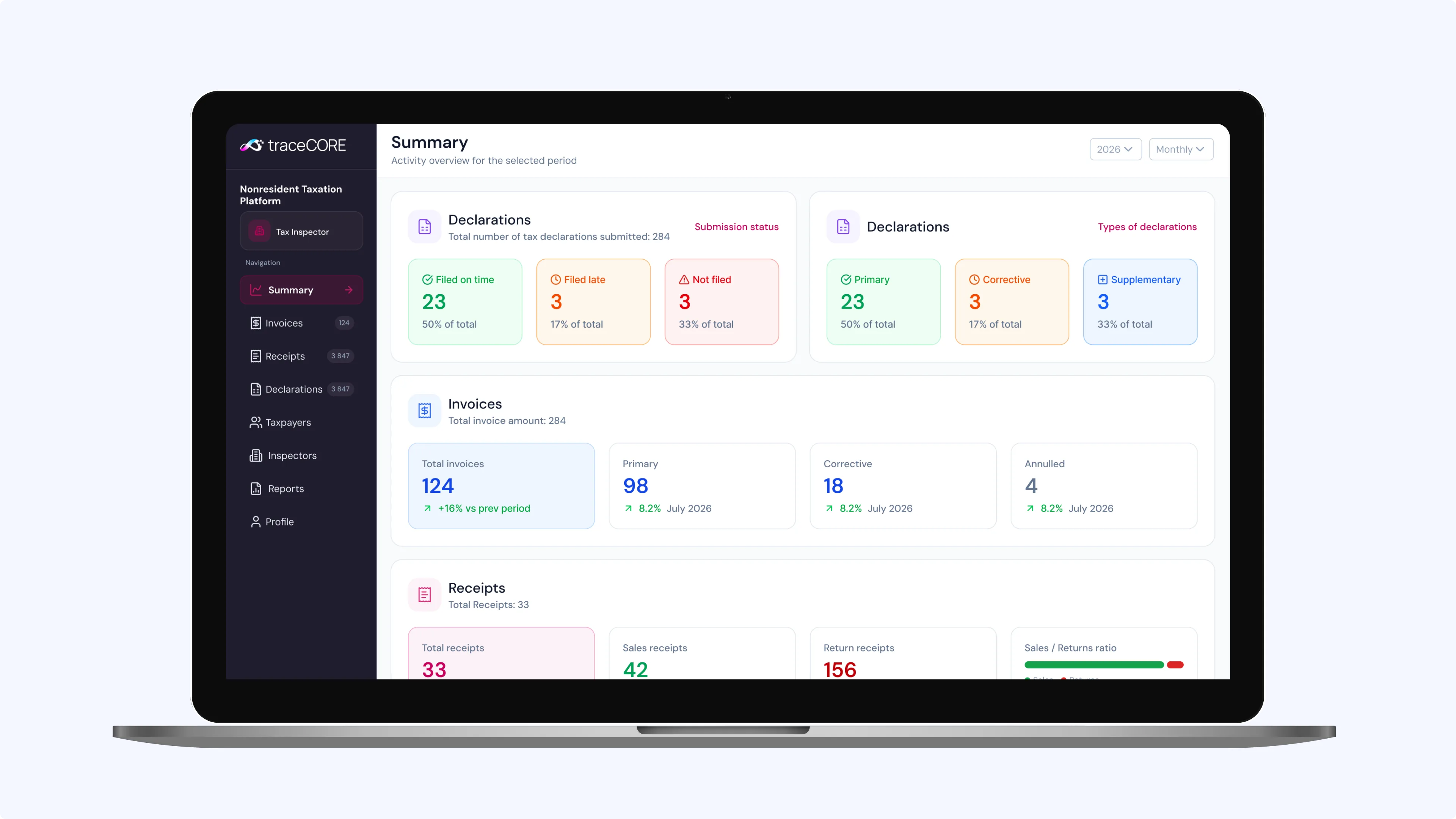
Rather than replacing existing tax systems, the solution offered by traceCORE complements them by providing dedicated capabilities for one of the most complex and rapidly evolving areas of modern tax administration.
If you're planning to implement digital transformation products and need expert help, traceCORE Advisory Support provides strategic guidance throughout the process.
Our team will assess your country's needs and define the right implementation approach to ensure your digital transformation delivers measurable, long-term results.
Closing the hidden revenue leak
The challenge of taxing nonresident businesses will only grow as global commerce becomes increasingly digital.
Governments that continue relying on manual enforcement risk falling further behind, allowing valuable public revenue to slip through the cracks. Those investing in digital compliance, automation, and intelligent enforcement are positioning themselves to protect their tax base while creating a more efficient, transparent, and equitable tax system.
The future of nonresident taxation is all about working smarter. With the right digital infrastructure in place, tax authorities can transform one of today's biggest compliance challenges into a measurable opportunity for sustainable revenue growth.